
How to Perform a DIY Choking Hazard Safety Check for Countdown Toys
An adult can perform a visual safety check for a choking hazard on these countdown toys, and that look is not a lab result. The listing says the toys meet United States toy standards and does not describe a small-parts test. If a piece is already loose, that vehicle should be set aside rather than treated as having passed a check.
How to perform a look, not a lab test
A choking hazard matters most when a small piece can come free and reach a child who puts objects in the mouth. This listing does not describe that risk, does not give a piece size, and does not report a pass or a fail. The safety sentence says the toys are safety tested and approved to United States toy standards for safe play. That sentence is not a diagram of parts. A household look cannot upgrade it into a certificate. The look only asks whether the vehicle in hand already shows a loose piece.
Perform the look without damaging the toy. Hold the day's pull-back vehicle. Look at wheels, edges, and any part that shifts under ordinary handling. Do not pry, twist until something breaks, or use a tool. A destructive pull is not a safety method, and the listing never asks for one. Do not place the vehicle or a piece in a child's mouth as a test. If nothing is loose, the look is finished and the standards sentence remains the only testing claim. If something is already detached or clearly loose, retire that vehicle from play. The other doors are a separate question for their own mornings.
A choking hazard the page does not score

Photo by Markus Spiske on Pexels
Because the page is silent, a few limits need to be said aloud. There is no cylinder size, no diameter, and no gauge in the description. A household that already owns a small-parts tester can use that tool on a piece that has come off. This listing does not include the tester and does not print a result to compare. Inventing a millimeter figure would pretend the seller measured something. The 24 vehicles are uniquely designed. A calm look at one does not certify the other 23. Materials are durable, high-quality, and built to last. Those words are not a promise that no piece can ever loosen, and they are not a repair manual.
Children who mouth toys need the stricter household rule, and the page does not identify those children. Toddler wording appears without a numeric age. An adult who knows a child still mouths objects should not hand over a loose piece, and may decide the whole set waits. That decision is care. It is not a finding printed on the product. Older children who do not mouth objects are also not given a year on the page. The check does not create an age rating. It does not replace supervision. Easy to carry and usable outdoors does not mean a loose piece is safe on a sidewalk. A loose vehicle stays off the floor entirely.
Countdown toys and pieces already loose
The countdown shape keeps the check small. Start on December 1. Open one door. Look at that vehicle. Leave later doors closed, both for the Christmas count and so 24 toys are not torn through in one sitting. A vehicle that looks intact can be rolled on a clear floor. The hand-and-eye motion is grip, draw back, release, and watch. None of that motion is a choking test. High-speed is an unmeasured play phrase, not a reason to strike the vehicle against a wall.
After the look, storage is ordinary. Intact vehicles go to a shelf an adult chooses. The listing does not describe a case. A set-aside vehicle should be kept where children do not play, not mixed back into the fleet. There is no instruction to glue, sand, or rebuild it. The price of $29.95 is the cost of the set, not a fee for a hazard certificate. Safety tested remains the seller's line. A careful visual check can sit beside that line. It cannot turn silence about choking into a pass the listing never wrote.
A household look versus a reported result
| Step | Careful version | Not this check | | --- | --- | --- | | Read | Standards sentence first | A named small-parts code | | Look | Pieces already loose | Prying until something breaks | | Mouthing | Keep pieces from the mouth | Using a child as the test | | If loose | Retire that vehicle | A homemade pass mark | | Pace | One opened door | A teardown of all 24 |
Steps before calling the look finished
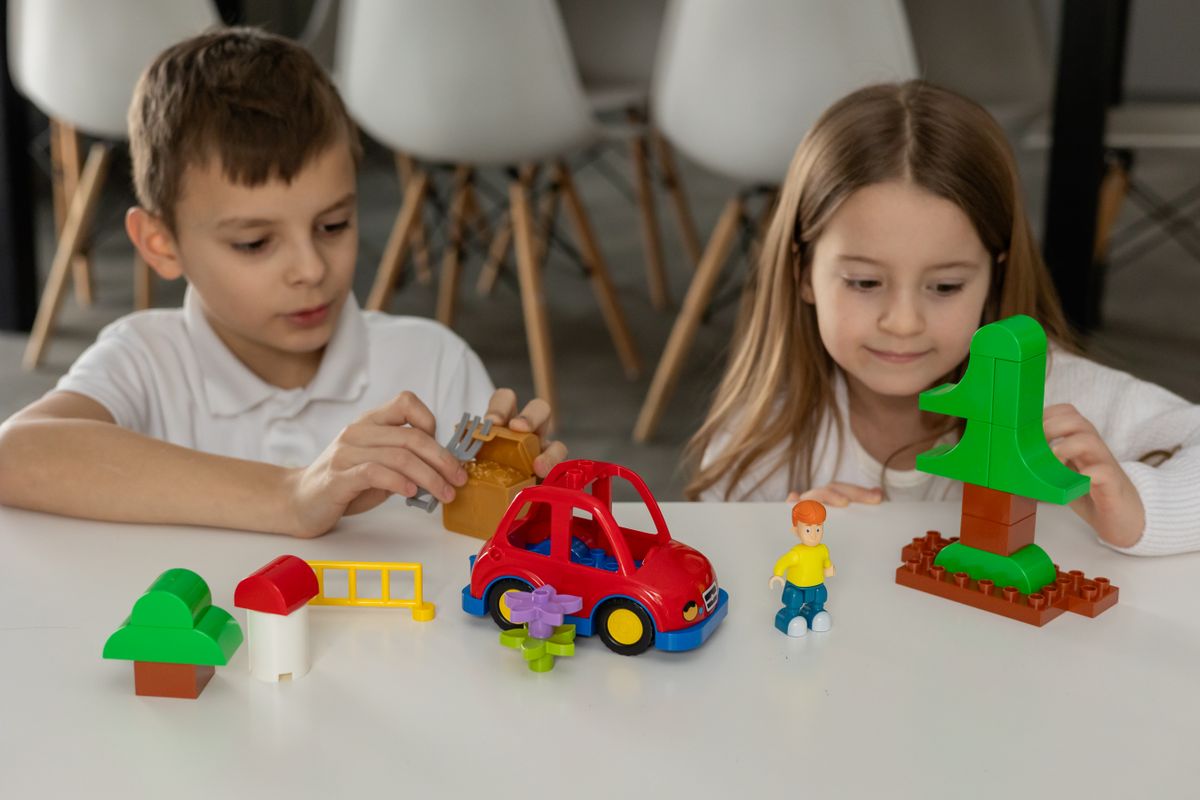
Photo by Polesie Toys on Pexels
- Read the standards line and note that no choking result is printed.
- Perform only a visual look plus ordinary handling, with no tools.
- Do not put a vehicle or a piece in anyone's mouth.
- Set aside a vehicle that already has a loose or detached piece.
- Do not treat one intact door as a certificate for the other doors.
- Keep the pace at one door a day from December 1.
- Leave $29.95 as price, not as proof of a hazard test.
Questions about choking and loose pieces
Does the listing report a choking result?
It does not report a choking-hazard result, a piece size, or a pass or fail. The printed safety line is United States toy standards for safe play.
Should parts be pulled off on purpose?
No. A careful check looks for pieces that are already loose under ordinary handling. Prying a vehicle apart is damage, not a method the listing describes.
What happens if a piece is loose?
That vehicle leaves play and stays where children cannot reach it. The look does not include a repair step, because no repair is described.
Does a calm look create an age rating?
It does not. Toddler wording is on the page, and a numeric age is not. Mouthing habits are a household fact the listing does not record.
Related reading
Related notes cover standards questions, missing material claims, and a durability buying pass.
- Questions on vehicle countdown safety standards
- What material claims are missing for outdoor play
- A holiday durability guide for race vehicles
What to do next
On December 1 an adult can read the standards sentence, look at the single opened vehicle, and either offer a short roll or set the vehicle aside. Nothing should be pried loose, and nothing should be tested in a mouth. The $29.95 listing still does not report a choking result, so the visual check stays a household look rather than a certificate.
Cover photo by Yan Krukau on Pexels.