Vehicle Play and Fine Motor Skills FAQ: How Daily Toy Discoveries Build Cognitive Growth
Daily vehicle discoveries can build the hand-and-eye practice the listing names, and they do not measure cognitive growth. The page says these toys can cultivate coordination of hands and eyes, which is the fine motor skills idea it actually supports. It does not print a motor score, a cognitive test, or a growth chart.
Daily discoveries and a named skill
A discovery, in ordinary family speech, is the moment a closed door opens and a new object appears. The listing's word is reveal. Each day from December 1, one door opens and one new pull-back vehicle comes out. Calling that moment a discovery does not add a cognitive claim. It only names the surprise the countdown is built to hold. There are 24 uniquely designed vehicles, so the reveal can look different each morning. The page does not say the designs teach 24 separate skills. One skill line is printed, and it is coordination.
Fine motor skills are a fair everyday label for the motion that follows the reveal, if the label stays humble. The child grips the vehicle, draws it backward, releases, and watches. Fingers, hands, and eyes take part. The listing's verb is cultivate, not score and not guarantee. Build, as a plain word for the same repetition, means practice stacked across days. It does not mean a measured gain. The listed price of $29.95 does not purchase an assessment.
How vehicle play can build a grip
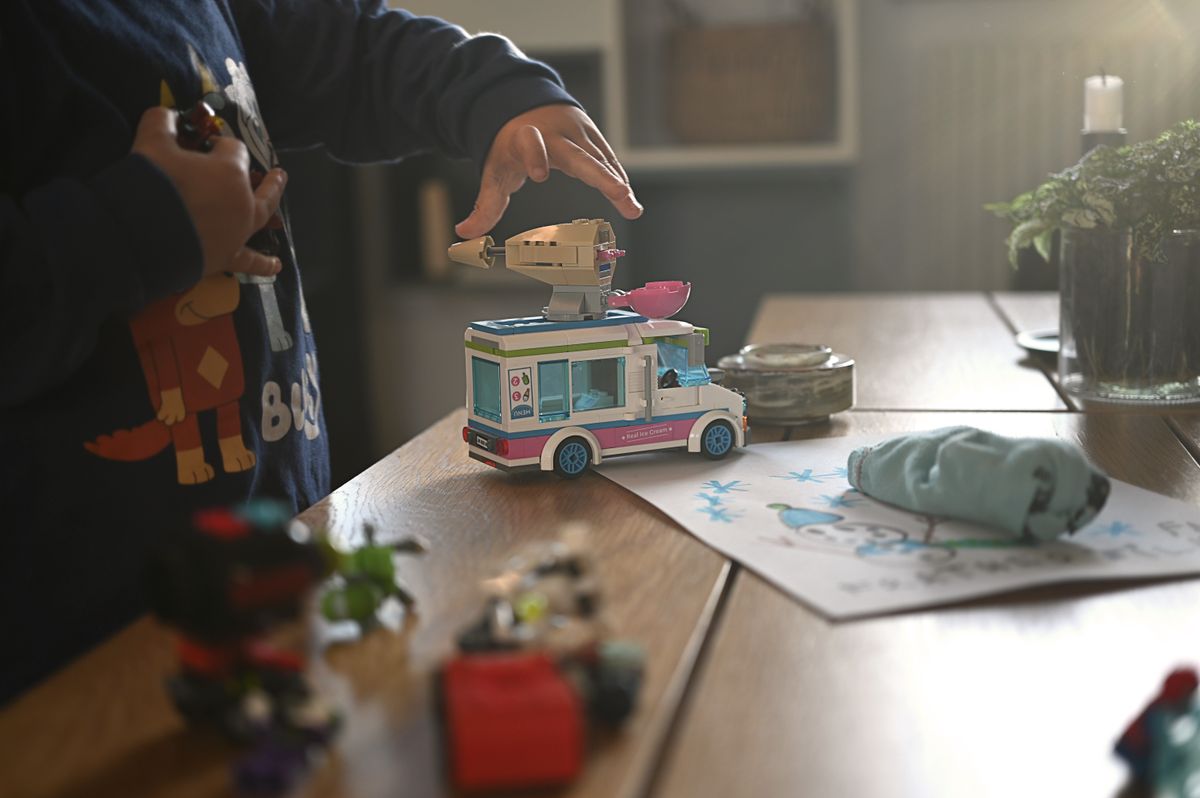
Photo by Kristian Bøgh on Pexels
Vehicle play of this kind is short and physical. A new vehicle has a shape the hand has not held yet, because the designs are unique. That newness can keep the same grip interesting. It can also mean the vehicle feels different, which is a reason for an adult to stay close, not a reason to assign a skill level. The page never prints a weight or a size, so difference is a possibility, not a chart. Children who like to collect, race, and explore can use yesterday's vehicles beside today's. A side-by-side roll is play. It is not a motor test with a winner.
The daily pace is what lets practice accumulate without a syllabus. One door, one new motion to try, and then the session can end. Later doors stay closed. Anticipation for the big day is part of the product description, and it is not a cognitive milestone. If a child only pushes, pushing is still vehicle play. It uses the hands in a simpler way and skips the pull-back release. The listing does not say every child will use the mechanism the same way. Materials that are durable, high-quality, and built to last describe the object that survives repeated grips. They do not describe a therapy outcome.
Cognitive growth the page does not score
Cognitive growth is a wide idea. It can mean attention, memory, language, or planning. This listing does not measure any of those, does not mention them, and should not be quoted as if it had. The coordination sentence is narrower. Hands do something. Eyes check the result. That loop can be called a piece of thinking in casual speech. Turning the casual speech into a growth percentage would be a different document. No before-and-after line appears. No age band with numbers appears either. Toddler wording is present. A number is not. An older child can use the same pull-back motion. Readiness is a household judgment.
Safety and setting do not convert into a development badge. The toys are safety tested and approved to United States toy standards for safe play. That sentence is about standards, not about cognitive endorsement. No code name and no laboratory are printed. The vehicles are easy to carry and can be used outdoors. A dry, flat roll gives the eyes a path to follow. It does not produce a growth score, and the street is not a classroom. The set is framed as an alternative to a tools countdown and as hands-on play. Those contrasts explain the contents. They do not explain a clinical result. Daily discoveries can build a habit of looking and releasing. Cognitive growth, as a measured change, remains outside the page.
Motor skills lines and their limits
| Phrase | What it supports | What it does not | | --- | --- | --- | | Hands and eyes | Coordination can be practiced | A motor score | | Daily reveal | One new vehicle to hold | A list of 24 skills | | Cultivate | The listing's own verb | A guaranteed gain | | Cognitive growth | Not printed at all | Attention or memory scores | | Price | $29.95 for the set | An assessment fee |
Reading a fine motor claim carefully
Photo by pipop kunachon on Pexels
- Quote the coordination sentence instead of a motor score.
- Use fine motor skills only as a plain label for grip and release.
- Call each morning a reveal, and do not score it as cognitive growth.
- Keep one door a day from December 1 so practice stays short.
- Stay nearby when a new shape feels different in the hand.
- Skip street play and any claim of a therapy result.
- Leave $29.95 as cost, not as proof of a developmental gain.
Questions about discoveries and growth
Does the listing promise cognitive growth?
The listing does not mention cognitive growth, attention, memory, or language gains. The skill sentence it does print is coordination of hands and eyes.
Are fine motor skills named on the page?
The page does not use the phrase fine motor skills. It says play can cultivate coordination of hands and eyes, which is the motion a grip and a release actually use.
What is a daily discovery here?
A daily discovery is an ordinary name for the reveal behind one door. The schedule is one new pull-back vehicle each day starting December 1, not a cognitive test.
Does repetition guarantee a gain?
Repetition can build familiarity with the same release. The listing's verb is cultivate, and it does not promise a measured gain or a growth chart.
Related reading
Development pages answer motor questions, describe non-candy toddler countdowns, and cover portable play safety.
- Parent questions on pull-back play and development
- A non-candy countdown aimed at toddlers
- Play and safety questions for portable vehicle fun
What to do next
An adult can open one door, offer a few releases, and stop when interest fades, without writing down a score. The coordination sentence is the claim to keep, and cognitive growth stays off the card because the listing does not measure it. The $29.95 price can be noted as the cost of 24 pull-back vehicles, not as the cost of an assessment.
Cover photo by Micah Eleazar on Pexels.